Switch from ThreatModeler
The ThreatModeler alternative built from your own docs, code, and policies
ThreatModeler, now combined with IriusRisk, is an established name in enterprise threat modeling. Clearly AI does that core work too: architecture diagrams, threats mapped to frameworks like STRIDE and MITRE ATT&CK, and audit-ready reports. The difference is where it starts. Clearly AI builds the diagram and the review from the design docs, tickets, and code you already have, cites every finding to its source, and runs your privacy, vendor risk, and AI reviews on the same platform.
Trusted by the companies you trust the most







Why teams switch
3 reasons teams move off traditional threat modeling tools
Most threat modeling tools need a system model before they can review anything: drawn, imported, or generated, then mapped to a library of threats and controls. Each review is only as good as that model and that library. And once the threat model is done, privacy, vendor, and AI reviews still run somewhere else.
Diagrams that draw themselves
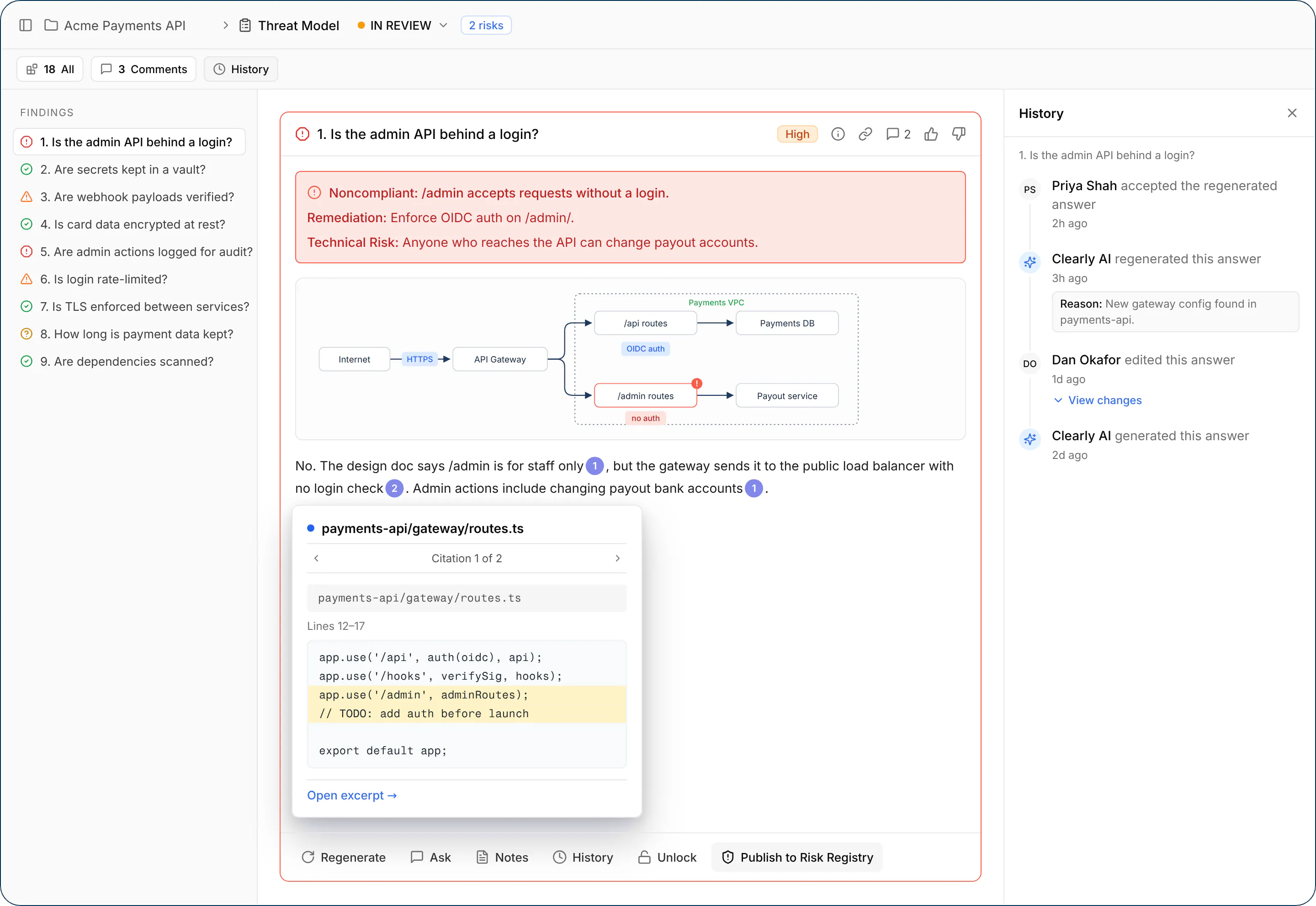
Clearly AI reads your design docs, tickets, and code and generates the architecture and data flow diagrams, trust boundaries, and threat model from them. No manual point and click to build the model first. Open the diagram in Draw.io inside the review, adjust it with your team, and the threat model updates to match.
Security expertise, applied to your standards
Every review draws on established frameworks like STRIDE, OWASP, MITRE ATT&CK, and MAESTRO, and on review templates built by security engineers who have run hundreds of critical reviews. Your policies, control libraries, and risk catalog apply alongside them. Every finding cites the document, ticket, or code behind it, so your reviewers can check the reasoning before they sign off.
Every review, one platform
Threat models, privacy impact assessments, vendor risk and AI risk reviews, and compliance control evaluations run on one platform, against your policies, with one audit trail. Your privacy and GRC teams use the same license.
Side by side comparison
ThreatModeler vs Clearly AI
Everything about ThreatModeler on this page comes from its public product pages and announcements, current as of October 2026. That includes ThreatModeler Nexus, generally available since June 2026. If something here is out of date, tell us at marketing@clearly-ai.com and we'll fix it!
| Capability |  | ThreatModeler |
|---|---|---|
| Where a review starts |
|
|
| Diagrams |
|
|
| Threat knowledge |
|
|
| How findings are produced |
|
|
| Review types |
|
|
| Tailoring to your standards |
|
|
| Workflow integration |
|
|
| Deployment and model control |
|
|
Where a review starts
Clearly AI
- A Jira ticket, design doc, repo, or vendor questionnaire
- Context gathered on its own
ThreatModeler
- A system map
- Drawn, imported, or built by Nexus agents from architecture artifacts or code
Diagrams
Clearly AI
- Architecture and data flow diagrams generated from your evidence
- Edited together in Draw.io, with the threat model updating to match
ThreatModeler
- A system map at the center of every model
- Built on a canvas or by the Nexus System Mapping Agent
Threat knowledge
Clearly AI
- Frameworks like STRIDE, OWASP, MITRE ATT&CK, PASTA, and MAESTRO
- Review templates built by Clearly AI security engineers
- Your policies, control libraries, and risk catalog
ThreatModeler
- The Secure Design Graph
- Curated threats, controls, and compliance mappings from ThreatModeler and IriusRisk
How findings are produced
Clearly AI
- Specialized agents reason over your system's own evidence
- Evaluated against your policies and controls
- Every finding cited to its source
ThreatModeler
- Nexus agents build and ground the system map
- A deterministic framework governs the outcome
Review types
Clearly AI
- Threat models
- Privacy impact assessments
- Vendor risk and AI risk reviews
- Compliance control evaluations
ThreatModeler
- Threat modeling and secure design
Tailoring to your standards
Clearly AI
- Upload a policy or control spreadsheet
- Live review template in hours
- Every template change versioned
ThreatModeler
- Admin-configured libraries and components
- Rules and workflows
Workflow integration
Clearly AI
- Auto-triggers from Jira, GitHub, ServiceNow, Azure DevOps, and Linear
- Findings route to Jira and Slack
- MCP server for AI coding tools
ThreatModeler
- Two-way Jira sync
- Git and CI/CD integrations
- IDE and AI coding tool integrations
Deployment and model control
Clearly AI
- Multi-tenant SaaS, single-tenant, or your own cloud
- SAML SSO, SCIM, customer-managed keys
- Bring your own model from OpenAI, Anthropic, or Amazon Bedrock
ThreatModeler
- Bring your own AI
- FedRAMP Moderate authorization through Knox Systems
Enterprise-ready
Your data stays yours. Your model stays your choice.
Deploy Clearly AI as multi-tenant SaaS, a dedicated single-tenant environment, or inside your own cloud, with SAML SSO, SCIM, and customer-managed keys. Bring your own model from OpenAI, Anthropic, or Amazon Bedrock. Clearly AI is SOC 2 Type II certified and never trains models on customer data. Every review is versioned against a specific project state, so you can show an auditor exactly what was reviewed, when, and why.
See how Clearly AI handles security and deployment


Proven outcomes
More of what ships, reviewed. With your existing team.
~90%
Reduction in time per review
4x
Review capacity with the same headcount
From 10 to
100%
Product coverage

“Weeks to minutes, literally.”
William Brown
Sr. Director of Product Security and Privacy

FAQ
Answers to your top questions
What is Clearly AI?
Clearly AI is a continuous threat modeling platform for security, privacy, and GRC teams. It gathers context from the artifacts your team already works from and delivers structured threat models, privacy impact assessments, vendor risk reviews, and AI governance evaluations, with every finding cited to its source. It was founded by security engineers who ran hundreds of critical reviews at Amazon. Explore the platform
How is Clearly AI different from ThreatModeler?
Both produce threat models with diagrams, mapped threats, and audit-ready reporting. ThreatModeler centers each model on a system map evaluated against its curated Secure Design Graph. Clearly AI generates the diagram and the review from your documentation, tickets, code, and policies, cites every finding to its source, and runs privacy, vendor risk, AI risk, and compliance reviews on the same platform. How tuning and accuracy work
ThreatModeler Nexus has AI agents now. Isn't that the same thing?
No. Nexus is a real step forward: its agents build a system map from architecture artifacts or code, and a deterministic framework grounded in ThreatModeler's Secure Design Graph governs the result. Clearly AI's agents reason over your system's own evidence against your own policies, cite every finding to its source, and cover every review type your team runs. The fastest way to see the difference is to run the same system through both.
Does Clearly AI have a threat library like ThreatModeler's?
Yes, in a different form. ThreatModeler's curated library is extensive. Clearly AI's threat knowledge comes from established frameworks like STRIDE, OWASP, MITRE ATT&CK, and MAESTRO, review templates built and maintained by Clearly AI's security engineers, and your own policies, control libraries, risk catalog, and past review decisions. Each review applies that knowledge to the evidence for the system in front of it, and every finding cites its source. See the risk registry and risk catalog
Does Clearly AI generate architecture diagrams automatically?
Yes. Clearly AI generates architecture and data flow diagrams, including trust boundaries, from your design docs, tickets, and code. There's no canvas to fill in first. Open the diagram in Draw.io inside the review to edit it with your team, and the threat model updates to match. See collaboration
Is Clearly AI also an alternative to IriusRisk?
Yes. IriusRisk is now part of ThreatModeler, and everything on this page applies to IriusRisk teams too. Clearly AI builds threat models from the artifacts your team already has, without a separate diagramming or library setup step.
What happens to our existing ThreatModeler or IriusRisk models?
They carry forward. Upload your existing ThreatModeler or IriusRisk threat models, and Clearly AI uses them as review context alongside your design docs, tickets, and code. There's nothing to migrate or redraw before your first review with Clearly AI.
Can we run Clearly AI side by side with ThreatModeler?
Yes. Most teams start with a sandbox using their own documents and templates, then an integrated evaluation connected to tools like Jira, ServiceNow, GitHub, or Azure DevOps. Run the same systems through both, and compare the results to your best security engineer's.
Getting started guide
Which methodologies and standards does Clearly AI support?
Clearly AI runs threat models against frameworks like STRIDE, MITRE ATT&CK, PASTA, LINDDUN, and MAESTRO, plus custom frameworks built from your own policies and control libraries. Upload a policy or control spreadsheet, and it becomes a live review template in hours. See the frameworks Clearly AI supports out of the box
Is continuous threat modeling the same as continuous monitoring?
No. Continuous threat modeling means every change that ships gets a threat model, triggered from tools like Jira and GitHub or run on a schedule. Each review is a point-in-time assessment of a specific project version. Clearly AI doesn't passively watch running systems or dashboards.
Where does our data live, and can we use our own model?
Clearly AI runs as multi-tenant SaaS, in a dedicated single-tenant environment, or inside your own cloud. Yes, you can bring your own model from OpenAI, Anthropic, or Amazon Bedrock, and Clearly AI never trains models on customer data. See security and deployment
Does Clearly AI replace our security engineers?
No. Clearly AI handles context gathering, drafting, and routing, so your engineers spend their time on risk decisions. Reviewers can challenge any finding, push back, and sign off.
When is ThreatModeler a better fit?
If you want library-driven, rules-based threat modeling as a system of record for application, cloud, and device security, ThreatModeler is a mature option. If you need diagrams and reviews built from your own evidence and policies across everything that ships, or your team also runs privacy, vendor, and AI reviews, Clearly AI is built for that.